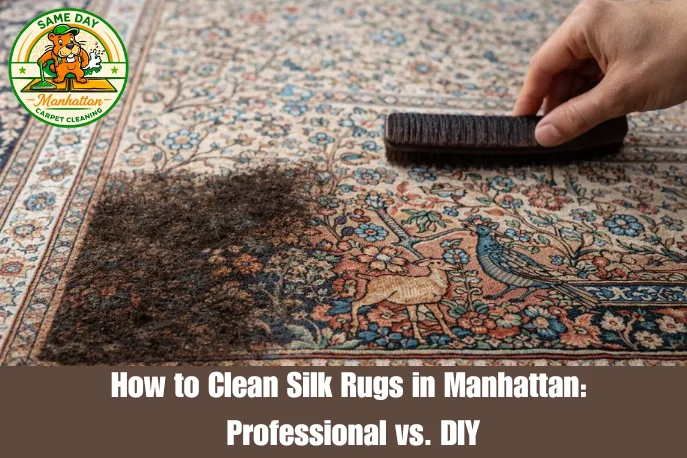
Silk rugs should never be cleaned with DIY methods the delicate fibers, hand-tied construction, and natural dyes require specialized professional treatment. Professional silk rug cleaning costs $4–$8 per square foot in Manhattan (around $200–$600 for a typical 5×8 rug) but protects your $2,000–$50,000+ investment. DIY attempts with home carpet cleaners, water-based solutions, or even vacuuming incorrectly can cause permanent color bleeding, fiber distortion, and irreversible damage that destroys the rug’s value.
If you own a silk rug in your Manhattan apartment, you already know it’s not just floor covering it’s an investment piece that demands careful maintenance. Whether it’s a Persian silk treasure in your Upper East Side home or a contemporary silk rug in your Tribeca loft, understanding the difference between professional and DIY cleaning can mean the difference between preserving beauty for generations and destroying thousands of dollars of value in a single afternoon. Below, we’ll explain exactly why silk rugs are different, what professional cleaning involves, why DIY is almost never appropriate, and how our team at Same Day Manhattan Carpet Cleaning handles these delicate pieces.
1. Why Silk Rugs Are Completely Different From Regular Carpet
Before we discuss cleaning methods, you need to understand what makes silk rugs uniquely fragile:
Fiber Structure
Silk is a natural protein fiber produced by silkworms essentially the same material as human hair. Individual silk fibers are extremely fine (10–25 microns diameter) and lack the resilience of wool or synthetic materials.
When wet, silk fibers lose up to 20% of their strength and become highly vulnerable to stretching, distortion, and breakage. This is why techniques that work fine on wool or nylon carpet will destroy silk.
Natural Dyes
Traditional silk rugs use vegetable-based dyes that aren’t colorfast when exposed to water, alkaline cleaners, or excessive agitation. Colors can bleed, run together, or fade completely with improper cleaning.
We’ve seen $15,000 silk rugs turned into worthless messes because someone used a home carpet cleaner with hot water the reds bled into whites, blues ran into yellows, and the intricate pattern became a muddy blur.
Hand-Knotted Construction
Quality silk rugs are hand-knotted, with each individual knot tied by hand. The foundation (warp and weft threads) is often silk as well, creating a delicate structure that can distort or separate if cleaned incorrectly.
Machine-made silk rugs have slightly more durability but still require professional care—the silk fibers themselves are just as fragile regardless of construction method.
Value Concentration
A 5×8 silk rug might be worth $3,000–$20,000 or more depending on origin, age, and craftsmanship. That’s $75–$500 per square foot of value you’re risking with improper cleaning.
Compare this to standard carpet at $3–$8 per square foot the stakes are completely different.
Stain Vulnerability
Silk absorbs liquids rapidly and holds stains tenaciously. What might be a minor wine spill on wool carpet becomes a major restoration project on silk because the fibers grab and hold pigments at the molecular level.
2. Professional Silk Rug Cleaning Process
Here’s what happens when you bring a silk rug to our silk rug cleaning specialists:
Step 1: Detailed Inspection & Documentation
We photograph the rug from multiple angles, document existing damage or wear, identify fiber content (some “silk” rugs are actually viscose/rayon which requires different treatment), and test dye stability in hidden areas.
This inspection takes 15–20 minutes and tells us exactly what cleaning approach is safe for your specific rug.
Step 2: Dry Soil Removal
Using specialized low-suction equipment and soft brushes, we remove surface dirt without damaging delicate fibers. Standard vacuums create too much suction and can pull out silk fibers or distort the weave.
For heavily soiled rugs, we use compressed air to blow dirt out of the pile rather than suctioning it gentler but equally effective.
Step 3: pH-Balanced Solution Application
Silk requires neutral pH cleaners (7.0–7.5) that won’t damage protein fibers or affect natural dyes. We apply cleaning solution with minimal moisture using hand tools never immersion washing unless the rug is structurally sound and dye-stable.
The solution sits for controlled dwell time (typically 5–10 minutes) while we monitor for any color bleeding or fiber reaction.
Step 4: Gentle Extraction
We extract cleaning solution using low-pressure equipment that removes soil without saturating the rug or stressing fibers. Silk rugs should never be soaking wet controlled moisture is critical.
For valuable or fragile pieces, we use dry compound cleaning methods that involve zero water, eliminating bleeding risk entirely.
Step 5: Controlled Drying
Silk rugs dry flat in climate-controlled conditions with air circulation but no direct heat. Hanging wet silk rugs causes distortion as the heavy, wet fibers stretch under their own weight.
Drying takes 24–48 hours depending on rug size and moisture content. Rushing this process with heat or fans causes shrinkage and distortion.
Step 6: Grooming & Final Inspection
Once dry, we groom the pile to restore luster and check for any issues that emerged during cleaning. The rug should look brighter, cleaner, and maintain its original dimensions and color integrity.
Typical Timeline & Cost:
| Service | Timeline | Cost (5×8 Silk Rug) |
|---|---|---|
| Basic cleaning (light soil) | 3–5 days | $200–$350 |
| Deep cleaning (moderate soil) | 5–7 days | $300–$500 |
| Restoration cleaning (heavy soil/stains) | 7–14 days | $500–$800+ |
| Rush service (when available) | 24–48 hours | Add 50–100% |
For Manhattan clients in Greenwich Village, SoHo, or anywhere across the city, we offer pickup and delivery service call (347) 594-1006 to arrange.
3. Why DIY Silk Rug Cleaning Almost Never Works
Let’s be completely honest about DIY silk rug cleaning: it’s a terrible idea in 95% of cases. Here’s why:
Home Carpet Cleaners Are Too Aggressive
Machines like Bissell, Hoover, or Rug Doctor use hot water extraction with strong suction. This combination:
- Over-saturates silk fibers causing color bleeding
- Creates excessive heat that can set stains permanently
- Applies too much mechanical agitation, distorting the weave
- Leaves rugs soaking wet, risking mold and mildew
We’ve cleaned up after dozens of DIY disasters where homeowners used rental carpet cleaners on silk rugs. The results are almost always catastrophic permanent color runs, stretched dimensions, and fiber damage.
Consumer Cleaning Products Have Wrong pH
Most carpet cleaning solutions sold in stores are alkaline (pH 9–11) because they work well on synthetic carpet and wool. On silk, alkaline cleaners:
- Break down protein fiber structure
- Cause yellowing or browning
- Strip natural oils that give silk its luster
- Weaken the rug permanently
Even “gentle” or “natural” products usually have inappropriate pH for silk.
Water Temperature Cannot Be Controlled
Silk cleaning requires cool to lukewarm water (65–75°F maximum). Hot water causes:
- Immediate and permanent color bleeding
- Fiber shrinkage and distortion
- Dye setting that makes stains impossible to remove later
- Weakening of the foundation structure
Home equipment doesn’t offer precise temperature control, and most people default to hot water thinking it cleans better.
Drying Is Nearly Impossible At Home
Manhattan apartments don’t have space to properly dry a silk rug flat. Hanging it wet causes distortion. Laying it on carpet transfers moisture and dye. Placing it outside exposes it to UV damage and pollutants.
Without climate-controlled flat drying, your silk rug will likely emerge from DIY cleaning distorted, shrunken, or mildewed.
No Dye Stability Testing
Professional cleaners test dye stability before cleaning. DIY attempts skip this step you won’t know your reds will bleed into whites until it’s already happened and irreversible.
Risk Far Exceeds Potential Savings
DIY cleaning might save you $200–$400 in professional fees. But if it goes wrong (and it usually does), you’re looking at:
- Complete rug replacement: $2,000–$50,000+
- Professional restoration attempts: $800–$2,000 (with no guarantee of success)
- Total loss of an heirloom or investment piece: Priceless
The math doesn’t work in DIY’s favor.
4. The Only Safe DIY Maintenance for Silk Rugs
While you should never attempt wet cleaning yourself, there are safe maintenance practices for between professional cleanings:
Gentle Vacuuming (With Extreme Caution)
Use a vacuum with adjustable suction set to the lowest setting and turn off the beater bar/brush roll completely. Vacuum in the direction of the pile only, using gentle strokes.
Frequency: Once weekly for high-traffic areas, bi-weekly for low-traffic areas.
Never vacuum fringes these delicate silk threads will get sucked into the vacuum and rip out. Clean fringes by hand with a soft brush if needed.
Immediate Spill Blotting
For liquid spills, blot immediately with white cotton cloth. Press firmly to absorb liquid but never rub or scrub. Work from outside edges toward center to prevent spreading.
Use only cool water if you must dampen the cloth—no cleaning solutions, no hot water, no rubbing.
For solid spills (food, dirt), let them dry completely then gently brush off with a soft natural-bristle brush.
Rotation
Rotate your silk rug 180 degrees every 6 months to distribute wear evenly and prevent traffic patterns. This is especially important in Manhattan apartments where furniture placement limits traffic pattern options.
Rug Pads
Use a proper rug pad underneath silk rugs to:
- Reduce friction and wear from foot traffic
- Prevent slipping (important on hardwood floors common in Manhattan apartments)
- Provide cushioning that extends rug life
- Improve air circulation underneath preventing mildew
Invest in natural rubber or felt pads avoid cheap PVC pads that can cause yellowing or chemical reactions with silk.
Professional Cleaning Schedule
Even with perfect maintenance, silk rugs need professional cleaning:
- Low traffic areas: Every 2–3 years
- Moderate traffic: Every 12–18 months
- High traffic or homes with pets: Annually
This prevents soil accumulation that becomes embedded and harder to remove over time.
5. Common Silk Rug Cleaning Mistakes to Avoid
Mistake #1: Using Store-Bought Spot Cleaners
Products like Resolve, OxiClean, or general carpet spot removers will permanently damage silk. They contain enzymes, bleaches, or alkaline chemicals that destroy silk fibers and cause color loss.
If you have a stain, blot with cool water only, then call professionals immediately.
Mistake #2: Steam Cleaning
Never use steam cleaners, steam mops, or any steam-based cleaning on silk. The heat and moisture combination causes instant color bleeding and fiber damage. This includes handheld garment steamers people sometimes try to use on rugs.
Mistake #3: Washing in Bathtub or Shower
Some DIY guides suggest washing small silk rugs in bathtubs. This is catastrophic advice. Full immersion in water causes:
- Complete color bleeding throughout the rug
- Foundation distortion and shrinkage
- Damage to backing materials
- Near-impossible proper drying in an apartment
Mistake #4: Using Regular Vacuum Beater Bars
The rotating brush on standard vacuums pulls out silk fibers, distorts the pile, and can unravel delicate edges. Always disable beater bars before vacuuming silk.
Better yet, use a handheld vacuum on lowest suction for safer cleaning.
Mistake #5: Sun Drying or Heat Drying
Placing wet or damp silk rugs in sunlight causes:
- UV damage and color fading
- Uneven drying leading to buckling
- Accelerated fiber degradation
Using heat sources (radiators, space heaters, hair dryers) causes shrinkage and fiber damage.
Mistake #6: Treating Silk Like Wool
Wool rugs tolerate water, agitation, and most cleaning products reasonably well. Silk doesn’t. What works for your wool rug will destroy your silk rug.
6. Silk vs. Viscose (Artificial Silk) – Critical Difference
Many “silk” rugs sold today are actually viscose (also called rayon or art silk) a plant-based fiber that looks like silk but costs far less.
How to Tell the Difference:
- Burn test: Real silk smells like burning hair when burned (protein). Viscose smells like burning paper (cellulose). Only test a single loose fiber from fringe never test the rug itself.
- Price: If your 5×8 “silk” rug cost under $1,000, it’s almost certainly viscose.
- Feel: Real silk has a luxurious, cool-to-touch feel with significant weight. Viscose feels lighter and less substantial.
- Sheen: Real silk has depth to its luster. Viscose has surface shine that looks artificial in bright light.
Cleaning Differences:
Viscose is even more fragile than silk when wet it can dissolve, lose shape completely, and develop permanent watermarks. Viscose rugs require specialized dry cleaning methods exclusively.
If you’re unsure whether your rug is silk or viscose, professional identification is critical before any cleaning attempts. Our rug cleaning specialists can identify fiber content accurately.
7. Specific Stain Treatment for Silk Rugs
Different stains require different professional approaches:
Wine, Coffee, or Food Stains
These organic stains penetrate silk fibers rapidly. Professional treatment involves:
- pH-neutral enzyme treatments that break down organic compounds
- Controlled moisture application to prevent bleeding
- Multiple gentle extraction passes
- Sometimes dry cleaning solvents for set-in stains
DIY attempts with water or cleaners almost always spread these stains or set them permanently.
Pet Accidents
Urine on silk is a serious problem the acid damages fibers and creates permanent odor if not treated immediately and properly. We use:
- Enzymatic treatments specifically formulated for protein fibers
- Sub-surface extraction to reach backing and foundation
- Odor neutralizers safe for silk
- Sometimes complete immersion cleaning if urine has fully saturated the rug
Our pet stain removal service handles these emergencies, though silk rugs require completely different chemistry than regular carpet.
Oil-Based Stains (Cooking Oil, Makeup, Grease)
These require dry cleaning solvents that dissolve oils without water. Water-based cleaning won’t touch oil stains and just spreads them further.
Professional dry cleaning equipment and solvents safely remove oil while protecting delicate silk fibers.
Ink or Dye Transfer
These are among the most difficult stains on silk. Success depends on:
- How long the stain has been there
- Type of ink or dye involved
- Color and dye stability of the rug itself
Professional restoration can sometimes improve these stains 50–70%, but complete removal isn’t always possible even with expert treatment.
8. Cost Comparison: Professional vs. DIY Silk Rug Cleaning
Let’s look at real costs:
DIY Attempt Costs:
- Rental carpet cleaner: $30–$50/day
- Cleaning solution: $15–$25
- Spot treatment products: $10–$20
- Time investment: 3–5 hours
- Total: $55–$95
DIY Risk Costs:
- Permanent color bleeding: Total rug loss ($2,000–$50,000+)
- Fiber damage: Permanent value reduction (50–100% of rug value)
- Shrinkage/distortion: Total rug loss or expensive restoration attempts
- Mold/mildew from improper drying: $300–$800 remediation + possible total loss
- Set-in stains from wrong cleaning approach: $500–$1,500 restoration attempts
Professional Silk Rug Cleaning:
- Basic cleaning (5×8 rug): $200–$350
- Deep cleaning with stain treatment: $300–$500
- Restoration cleaning: $500–$800
- Pickup and delivery in Manhattan: $50–$100
- Success rate: 95%+ for properly cleanable rugs
The Math:
Professional cleaning costs 3–10x more than DIY attempts upfront but eliminates the 50–80% risk of total rug loss. On a $5,000 silk rug:
- Professional cleaning: $300 (6% of rug value)
- DIY disaster risk: $5,000 total loss (100% of rug value)
The choice is obvious for anyone with a silk rug worth more than $500.
9. When to Call Professionals Immediately
Call our silk rug cleaning specialists immediately in these situations:
Any Liquid Spill
Wine, coffee, juice, pet urine, or any liquid that penetrates the rug needs professional treatment within 24–48 hours. After that window, stains set permanently and become exponentially harder to remove.
Visible Soil Accumulation
If your silk rug looks dingy, has lost its luster, or shows visible dirt in traffic areas, it needs professional cleaning. Waiting longer allows soil to abrade fibers and cause permanent damage.
Post-Renovation or Construction
Manhattan apartment renovations create fine dust that settles into silk rugs and acts like sandpaper on delicate fibers. Professional cleaning after construction prevents this abrasive damage.
Before Special Events or Staging
If you’re preparing your Manhattan apartment for sale, hosting an event, or want your rug looking its absolute best, schedule professional cleaning 2–3 weeks in advance.
Moving or Storage Preparation
Silk rugs should be professionally cleaned before long-term storage to prevent moth damage and prevent soil from setting during storage. We also offer proper wrapping and storage preparation.
Unknown Previous Damage
If you inherited a silk rug or purchased a vintage piece, professional inspection and cleaning establishes baseline condition and addresses hidden issues before they worsen.
10. Manhattan-Specific Silk Rug Considerations
Living in Manhattan presents unique challenges for silk rug care:
Building Restrictions
Many Manhattan buildings prohibit wet cleaning in apartments due to water damage risk. This makes professional pickup and cleaning at our facility the only viable option.
High-rise buildings in Midtown East, Battery Park City, or Hudson Yards often require advance notice for moving large items we coordinate this for you.
Air Quality Issues
Urban air pollution means Manhattan silk rugs accumulate more particulate matter than suburban rugs. This accelerates the need for professional cleaning typically every 12–18 months versus 2–3 years elsewhere.
Humidity Fluctuations
Pre-war buildings with radiator heat create extreme dryness in winter, making silk brittle. Summer humidity in buildings without AC causes silk to absorb moisture, making it vulnerable to mildew.
Professional cleaning includes treatments that help silk rugs handle these fluctuations better.
Limited Drying Space
Manhattan apartments simply don’t have floor space to properly dry a silk rug after DIY cleaning attempts. Our climate-controlled facility provides flat drying in ideal conditions.
High-Value Concentration
Manhattan homes often have expensive silk rugs in relatively small spaces a $20,000 Persian silk in an 800-square-foot apartment isn’t unusual. The risk-to-reward ratio for DIY strongly favors professional service.
11. Alternative Cleaning for Other Rug Types
While silk demands professional care, other rug types have different requirements:
Persian Rugs (Wool)
Wool Persian rugs tolerate water and cleaning better than silk, though valuable antiques still need professional care. Our Persian rug cleaning service handles these with appropriate methods.
Oriental Rugs (Various Materials)
Oriental rug cleaning depends on fiber content. Wool orientals are more forgiving, while silk orientals require the same careful treatment discussed above.
Antique Rugs
Age adds fragility regardless of fiber type. Antique rug cleaning requires specialized knowledge of historical construction methods and dyes.
Area Rugs (Synthetic)
Modern synthetic area rugs tolerate DIY cleaning better, though professional treatment still delivers superior results.
Wool Rugs
Wool rug cleaning is more forgiving than silk but still benefits from professional care, especially for valuable pieces.
12. Questions to Ask Professional Silk Rug Cleaners
Not all carpet cleaners can handle silk properly. Ask these questions before trusting your valuable rug to anyone:
“Do you clean silk rugs on-site or at a facility?”
Proper answer: “At our facility.” In-home silk rug cleaning is nearly impossible you need specialized equipment, controlled environment, and proper drying space.
Be wary of services that claim they can effectively clean silk rugs in your apartment.
“What is your process for dye stability testing?”
Proper answer: Should describe testing hidden areas with cleaning solution and monitoring for color bleeding before proceeding.
If they say “we just clean it,” they don’t understand silk.
“How do you dry silk rugs after cleaning?”
Proper answer: “Flat drying in climate-controlled space with air circulation but no direct heat.”
Wrong answers: Hanging to dry, outdoor drying, heat drying, or “it dries in a few hours.”
“What happens if color bleeding occurs during cleaning?”
Proper answer: Should describe stopping immediately, color restoration attempts, and honest discussion about whether the rug can be safely cleaned.
If they say “that never happens,” they’re either lying or inexperienced with silk.
“Can I see examples of silk rugs you’ve cleaned?”
Reputable services keep before/after photos of silk rug cleaning projects and can provide references from clients with similar rugs.
“Do you offer pickup and delivery in Manhattan?”
For valuable silk rugs, you want white-glove service including pickup, cleaning, and delivery. We offer this throughout Manhattan from Marble Hill to Governors Island.
13. Insurance and Documentation
Document Your Rug Before Cleaning:
Take detailed photos from multiple angles, including:
- Full rug from above
- Close-ups of all four corners
- Any existing damage or wear
- Fringe condition
- Back of rug showing construction
This documentation protects both you and the cleaning service.
Verify Insurance Coverage:
Ask for proof that the cleaning company carries:
- Liability insurance covering valuable rug damage
- Workers compensation (protects you from liability)
- Specific coverage for high-value items
For rugs worth over $5,000, consider getting your own appraisal and specific insurance rider.
Get Written Estimates:
Professional silk rug cleaning estimates should specify:
- Square footage and measurement
- Identified fiber content
- Cleaning method to be used
- Timeline for service
- Total cost including pickup/delivery
- What’s included (stain treatment, etc.)
- Guarantee or warranty terms
Summary: Professional Silk Rug Cleaning Is Non-Negotiable
For Silk Rugs Worth Over $500:
Never attempt DIY wet cleaning. The risk of permanent damage is 50–80%, and the cost of failure (total rug loss) far exceeds professional cleaning costs.
Safe DIY Maintenance:
- Gentle vacuuming (no beater bar, low suction)
- Immediate spill blotting with cool water only
- Rotation every 6 months
- Professional cleaning every 12–24 months
When to Call Professionals:
- Any stain or spill
- Visible soil accumulation
- Before storage or moving
- After renovation/construction
- Annual or bi-annual maintenance
Professional Cleaning Costs:
- Basic: $200–$350 (5×8 rug)
- Deep cleaning: $300–$500
- Restoration: $500–$800+
- Pickup/delivery: $50–$100
DIY Attempt Costs:
- Upfront: $55–$95
- Failure risk: Total rug loss ($2,000–$50,000+)
The bottom line: silk rugs are investment pieces that demand professional care. The delicate fiber structure, natural dyes, hand-knotted construction, and high value make DIY cleaning an unacceptable risk. What you save in cleaning fees you’ll lose many times over if DIY goes wrong and it almost always does with silk.
Manhattan living already presents challenges for rug care limited space, air pollution, humidity fluctuations, building restrictions. Don’t compound these by attempting DIY cleaning that puts your investment at risk.
We’re located at 41 Perry St in the West Village and have been cleaning valuable silk rugs for Manhattan residents across every neighborhood from Upper West Side to Financial District, Harlem to Chinatown. Call us at (347) 594-1006 to discuss your silk rug’s specific needs, schedule pickup, or get a detailed estimate based on your rug’s size, condition, and fiber content.