Most food stains on upholstery can be removed within 15-30 minutes if treated immediately, but waiting 24+ hours makes them permanent and requires professional cleaning costing $80-$200 per piece. The key is knowing which stains need water, which need solvent, and which ones you should never attempt yourself.
Food stains on upholstery are inevitable in Manhattan apartments spilled coffee during your morning commute prep, pizza grease on movie night, or wine at dinner parties. At Same Day Manhattan Carpet Cleaning, we handle food stain emergencies daily across Manhattan, from SoHo lofts to Upper East Side apartments. Below, I’ll walk you through exactly how to handle every common food stain and when to call professionals before you make it worse.
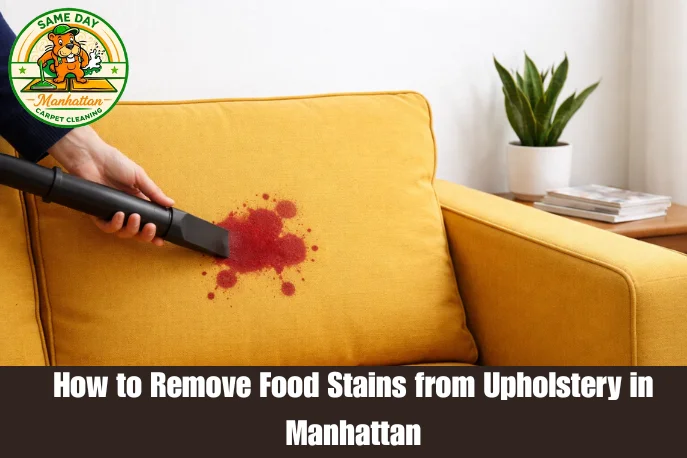
Why Food Stains Are Trickier Than You Think
Food stains fall into three categories, and using the wrong cleaning method can set the stain permanently:
- Water-based stains: Coffee, tea, juice, soda, most sauces
- Oil-based stains: Butter, grease, salad dressing, chocolate
- Combination stains: Pizza, pasta sauce, gravy (contain both water and oil)
The fabric type matters just as much as the stain type. What works on microfiber upholstery can destroy leather furniture or velvet.
First Things First: Check Your Furniture’s Cleaning Code
Every piece of upholstered furniture has a tag (usually under the cushions) with a cleaning code. This code determines what you can safely use:
| Code | Meaning | Safe to Use | Never Use |
|---|---|---|---|
| W | Water-based cleaners only | Water, mild detergent | Solvents, alcohol |
| S | Solvent-based cleaners only | Dry cleaning solvent, rubbing alcohol | Water (causes watermarks) |
| SW or W/S | Either water or solvent | Both options available | Nothing specific |
| X | Professional cleaning only | Vacuum only | Any liquids or chemicals |
Critical mistake: 70% of the upholstery damage we see comes from people using water on “S” code fabrics or solvents on “W” code fabrics. Always check the tag first.
The Universal Rules for Any Food Stain
Before we get into specific stains, these rules apply to everything:
Rule 1: Speed matters more than method
- Treat stains within 5 minutes for best results
- After 1 hour, success rates drop 50%
- After 24 hours, many stains become permanent
Rule 2: Blot, never rub
- Press straight down with a clean white cloth
- Lift and move to a clean section
- Rubbing spreads the stain and damages fabric fibers
Rule 3: Work outside-in
- Always start at the stain edges
- Move toward the center
- This prevents spreading
Rule 4: Test everything
- Test cleaning solutions in a hidden area first
- Wait 10 minutes to check for damage
- Never skip this step
Rule 5: Less is more
- Use the minimum amount of cleaning solution
- Multiple light applications beat one heavy application
- Excess moisture causes new problems (mold, watermarks, backing damage)
Common Food Stains: Step-by-Step Removal
Coffee and Tea Stains
Type: Water-based Difficulty: Easy (if fresh) Time to act: Within 30 minutes
What you need:
- White cloths or paper towels
- Cool water
- White vinegar
- Mild dish soap (clear, no dyes)
The process:
- Blot immediately with dry cloth remove as much liquid as possible
- Mix solution: 1 tablespoon white vinegar + 2 cups cool water
- Dampen cloth with solution (not soaking wet)
- Blot stain from outside edges toward center
- Rinse: Use clean cloth dampened with plain water
- Dry thoroughly: Blot with dry towels, aim fan at area
If the stain persists: Add 1 drop of clear dish soap to the vinegar solution. If it’s still there after this, call professionals you’ve done everything safe to do yourself.
Red Wine
Type: Water-based (but tricky) Difficulty: Moderate to difficult Time to act: Immediately
Critical: Red wine oxidizes and sets within minutes. Every second counts.
Immediate response:
- Blot excess wine immediately
- Cover with salt: Pour table salt liberally over the wet stain (absorbs wine)
- Let sit 3-5 minutes
- Vacuum up salt
- Club soda method: Pour small amount of club soda on remaining stain
- Blot repeatedly until no more color transfers
For dried wine stains: These require professional stain removal. Home methods won’t work and can set the stain permanently.
Cost reality: Professional wine stain removal costs $80-$150 vs. $800-$3,000 to reupholster a stained couch.
Grease and Oil (Butter, Cooking Oil, Salad Dressing)
Type: Oil-based Difficulty: Moderate Time to act: Within 1 hour
What you need:
- Cornstarch or baking soda
- Dry cleaning solvent (for “S” or “SW” fabrics only)
- White cloths
The process:
- Remove solids: Gently scrape off excess oil with spoon edge
- Absorb oil: Cover stain with cornstarch or baking soda
- Let sit: 15-30 minutes (absorbs oil from fabric)
- Vacuum: Remove powder completely
- For remaining stain (S or SW fabrics only): Apply small amount of dry cleaning solvent to cloth, blot stain
- Air dry: Let fabric dry completely
For W-code fabrics: Use dish soap method mix 1 drop clear dish soap with 2 cups cool water, blot stain, rinse with plain water.
What not to do: Never use water first on oil stains. Water sets oil-based stains permanently.
Chocolate
Type: Combination (oil + protein) Difficulty: Moderate Time to act: Within 30 minutes
The process:
- Scrape off excess chocolate gently
- Freeze it: Place ice pack on remaining chocolate for 5 minutes (hardens it)
- Break and remove: Hardened chocolate chips off easily
- Treat residue: Use method based on fabric code
- W fabrics: Cool water with 1 drop dish soap
- S fabrics: Dry cleaning solvent
- Blot and rinse: Work from outside in
- Dry thoroughly: Fan for 2-3 hours
Tomato Sauce (Pizza, Pasta, Ketchup)
Type: Combination (oil + acid) Difficulty: Moderate to difficult Time to act: Within 15 minutes
The process:
- Remove excess: Scoop off sauce without spreading
- Cold water only: Never use hot water (sets the stain)
- Blot with cold water: Use barely damp cloth
- Vinegar solution: 1 tablespoon vinegar + 1 cup cold water
- Work from edges: Blot toward center
- Repeat: May need 3-4 applications
- Address oil residue: If greasy stain remains, use appropriate oil removal method for your fabric code
Warning: Tomato stains are acidic and can damage certain fabrics. If the stain doesn’t respond to 2-3 attempts, stop and call professionals.
Mustard
Type: Water-based with dye Difficulty: Difficult Time to act: Immediately
Reality check: Mustard contains turmeric, a natural dye that bonds to fabric instantly. Even professional removal isn’t always 100% successful.
Immediate steps:
- Scrape off excess mustard
- Don’t rub: This pushes dye deeper
- Glycerin treatment (if available): Apply pure glycerin, let sit 30 minutes
- Rinse with cool water: Blot repeatedly
- Call professionals: If any yellow remains, only professional treatment can help
Cost: Professional mustard stain removal: $100-$200. Success rate: 70-80% for fresh stains, 20-30% for old stains.
Berry Stains (Blueberries, Strawberries)
Type: Water-based with natural dye Difficulty: Moderate Time to act: Within 30 minutes
The process:
- Remove fruit: Pick off any berry pieces
- Flush with cold water: Blot with cold water repeatedly
- Hydrogen peroxide (light fabrics only): Test first, then apply small amount
- Let sit 5 minutes
- Blot with cold water: Remove peroxide
- Repeat if needed
Never use on: Dark fabrics (peroxide may bleach), silk, wool, or fabrics without testing first.
Food Stain Removal by Fabric Type
| Fabric Type | Safe DIY Methods | Avoid | When to Call Pros |
|---|---|---|---|
| Cotton/Linen | Water-based solutions, mild soap | Harsh chemicals, hot water | Oil stains, dye-based stains |
| Microfiber | Rubbing alcohol (for S-code), water (for W-code) | Too much liquid | Large stains, unknown stain types |
| Polyester | Most water-based methods | Acetone, harsh solvents | Set-in stains |
| Leather | Specialized leather cleaner only | Water, vinegar, harsh chemicals | Any liquid stains |
| Velvet | Professional only for stains | Any liquids, rubbing | All food stains |
| Silk | Professional only | Any home treatment | All stains |
| Wool | Cool water, wool-safe detergent | Hot water, alkaline cleaners | Protein stains (milk, egg) |
What Requires Professional Treatment
Some situations are beyond safe DIY:
Immediate professional help needed:
- Stains on “X” code fabrics
- Red wine older than 1 hour
- Grease on light-colored silk or velvet
- Any stain on antique upholstery
- Combination stains that don’t respond to first treatment
- Stains on expensive designer furniture
Signs your DIY made it worse:
- Stain is spreading
- Color is bleeding
- Fabric texture changed
- Watermarks appeared
- Smell developed
Stop immediately and call us at +1 (347) 594-1006 if any of these occur.
Manhattan-Specific Challenges
Small Apartment Logistics
Manhattan apartments make upholstery stain removal harder:
- Limited ventilation: Fabrics take forever to dry
- No outdoor space: Can’t take furniture outside for treatment
- Small bathrooms: Hard to rinse large cushions
- No garage: Nowhere to store furniture while drying
Our solution: We offer on-site emergency stain treatment or can pick up cushion covers for cleaning at our facility.
High-Rise Building Concerns
Living on the 20th floor of a Midtown building creates unique problems:
- Can’t risk water damage to downstairs neighbors
- Building rules prohibit certain cleaning methods
- Can’t move heavy furniture easily
We understand these constraints and work within building requirements throughout Manhattan neighborhoods.
Quick Turnaround Needs
Manhattan life moves fast. You need solutions that work with your schedule:
- Same-day service: Call before 2 PM for service today
- Evening appointments: We work around your schedule
- Weekend availability: Don’t wait until Monday to treat stains
Cost Comparison: DIY vs. Professional
DIY Food Stain Treatment:
- Cleaning supplies: $20-$40
- Time: 30-90 minutes
- Success rate: 60-70% for fresh stains
- Risk of damage: 20-30%
Professional Stain Removal:
- Single stain treatment: $80-$150
- Time: We handle it (1-2 hours)
- Success rate: 90-95% for fresh stains
- Risk of damage: <1%
Reupholstery Costs (if DIY fails):
- Armchair: $800-$1,500
- Sofa: $2,000-$5,000
- Sectional: $3,000-$8,000+
The math: Spending $100 on professional stain removal beats spending $3,000 on reupholstery.
Our Professional Food Stain Removal Process
When you call Same Day Manhattan Carpet Cleaning for food stain removal:
- Emergency response: Same-day service throughout Manhattan if you call by 2 PM
- Stain identification: We determine exact stain type and best treatment
- Fabric analysis: Check cleaning codes and fiber content
- Specialized treatment: Use commercial-grade products not available to consumers
- Complete removal: Treat both visible stain and hidden residue
- Odor elimination: Remove food smells that DIY methods leave behind
- Fabric protection: Optional stain-resistant treatment to prevent future stains
Average turnaround: 2-4 hours for on-site treatment, 24-48 hours for pickup service.
Prevention: Protecting Your Upholstery
Immediate protection options:
- Fabric protector treatment: $40-$80 per piece, repels liquid stains
- Throws and covers: Washable protection for high-use areas
- Regular professional cleaning: Every 12-18 months prevents soil buildup that makes stains harder to remove
Manhattan lifestyle tip: If you entertain frequently in your Chelsea apartment or have kids in your Upper West Side home, fabric protection pays for itself after preventing just 1-2 major stains.
Emergency Stain Removal Pricing
| Stain Type | Difficulty | Cost Range | Time to Complete |
|---|---|---|---|
| Coffee/Tea (fresh) | Easy | $60-$100 | 30-60 minutes |
| Wine (fresh) | Moderate | $80-$150 | 1-2 hours |
| Wine (old/set) | Difficult | $150-$250 | 2-4 hours |
| Grease/Oil | Moderate | $80-$130 | 1-2 hours |
| Tomato sauce | Moderate | $90-$150 | 1-2 hours |
| Chocolate | Moderate | $80-$130 | 1-2 hours |
| Mustard | Difficult | $100-$200 | 2-3 hours |
| Multiple stains | Varies | $150-$300+ | 2-4 hours |
Add $50-$100 for pet stain complications or odor removal.
Pro Tips from 15+ Years Removing Food Stains
- Keep an emergency kit: White cloths, club soda, white vinegar, cornstarch. These handle 80% of food stains.
- Room temperature water only: Hot water sets protein stains (milk, egg, meat), cold water works best for most food stains.
- White cloths matter: Colored cloths can transfer dye to your upholstery during treatment.
- Blot dry completely: Moisture left in upholstery causes mold, especially in humid Manhattan summers.
- Don’t use colored cleaning products: That blue dish soap or pink stain remover can dye your fabric.
- Stop after 3 attempts: If a stain doesn’t respond to 2-3 proper treatments, additional attempts risk damage. Call professionals.
- Document for landlords: Take photos before and after stain treatment if you’re renting.
When Same-Day Service Is Essential
Call us immediately for same-day upholstery cleaning when:
- Red wine on white or light-colored furniture
- Large food spills before an important event
- Stains on expensive or antique pieces
- Moving out and need furniture spotless for landlord inspection
- DIY attempts made the stain worse
- Stains on unknown fabric types
Available throughout Manhattan: From Financial District to Harlem, Greenwich Village to Tribeca.
The Bottom Line
Most food stains on upholstery can be removed if treated within 30 minutes using the right method for your fabric type. Check your furniture’s cleaning code first, blot (never rub), and use the minimum amount of cleaning solution. When DIY isn’t working or the stain is high-risk (wine, mustard, grease on expensive fabric), professional treatment costs $80-$200 versus $2,000-$5,000 for reupholstery.
At our Perry St location, we’ve treated every food stain Manhattan throws at upholstery from couch cleaning after dinner parties to emergency stain removal before landlord inspections. We know which stains you can handle yourself and which ones need professional treatment immediately.
For food stain emergencies throughout Manhattan including residential and commercial properties call Same Day Manhattan Carpet Cleaning at +1 (347) 594-1006.
Don’t let a food stain ruin your favorite furniture. Act fast, use the right method, and know when to call for help.